
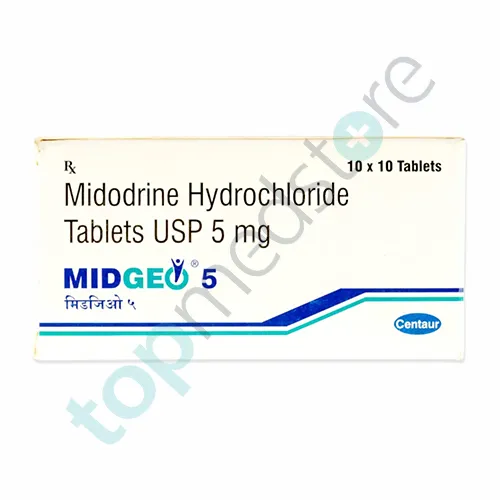
Midodrine 5mg
$85.80 – $280.80
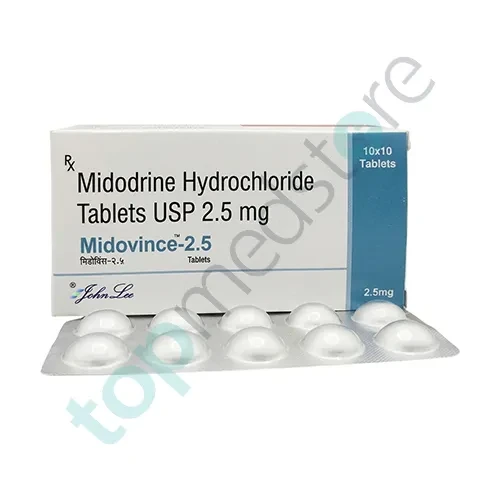
| Product name | Midodrine 2.5mg |
|---|---|
| Active Ingredient | Midodrine |
| Dosage | 2.5mg |
| Drug Type | Tablets |
| Indication | Orthostatic Hypotension |
| Manufacturer | Healing Pharma |
Total $46.20
Midodrine 2.5mg Tablet is a prescription medicine used to treat low blood pressure (hypotension, a condition where blood pressure becomes too low and may reduce blood flow to vital organs).
This medicine belongs to the vasopressor class (drugs that increase blood pressure by tightening blood vessels). It is mainly used in patients who experience symptoms of low blood pressure such as dizziness, fainting, or weakness.
Doctors, especially cardiologists (heart specialists) and general physicians, prescribe Midodrine 2.5mg Tablet based on the severity and cause of low blood pressure.
Blood pressure is the force of blood pushing against the walls of blood vessels. It is needed to supply oxygen and nutrients to organs like the brain, heart, and kidneys.
In some conditions, blood pressure drops too low. This condition is called hypotension, and it can cause symptoms such as dizziness, fainting, blurred vision, fatigue, and difficulty concentrating.
Low blood pressure can occur due to dehydration, certain medications, nerve problems, or long-term illnesses.
Midodrine 2.5mg Tablet works by tightening blood vessels in the body.
It activates certain receptors in the blood vessels called alpha-adrenergic receptors (sites that control blood vessel tightening and relaxation).
When these receptors are activated, blood vessels become narrower.
This increases blood pressure and improves blood flow to vital organs.
As a result, symptoms of low blood pressure such as dizziness and fainting are reduced.
Midodrine 2.5mg Tablet is mainly used for treating orthostatic hypotension (a condition where blood pressure drops when a person stands up suddenly).
It is also used in patients who experience chronic low blood pressure due to nerve-related conditions or other medical causes.
This medicine helps reduce symptoms like lightheadedness, fainting spells, and weakness.
It improves a patient’s ability to stand, walk, and perform daily activities without sudden drops in blood pressure.
It is often used when lifestyle changes alone are not enough to manage low blood pressure.
Midodrine 2.5mg Tablet works by stimulating alpha-1 adrenergic receptors (receptors in blood vessels responsible for contraction and tightening).
When these receptors are activated, the smooth muscles in blood vessel walls contract.
This causes the blood vessels to narrow, a process called vasoconstriction (tightening of blood vessels).
As blood vessels narrow, blood pressure increases.
This helps improve blood flow to the brain and other vital organs.
The effect helps reduce symptoms like dizziness and fainting, especially when standing up.
Some patients may experience side effects, especially during initial treatment.
A common effect is goosebumps or tingling sensation, due to blood vessel tightening.
Some patients may feel itching of the scalp or skin.
In some cases, urinary retention (difficulty in passing urine) may occur.
Other possible effects include high blood pressure while lying down (supine hypertension), headache, or chills.
Some individuals may experience nausea or stomach discomfort.
Most side effects are manageable with proper dose adjustment and medical supervision.
Midodrine 2.5mg Tablet should be taken exactly as prescribed by the doctor.
It is usually avoided close to bedtime because it may cause high blood pressure while lying down.
Patients should monitor their blood pressure regularly while using this medicine.
People with heart disease, kidney disease, or urinary problems should inform their doctor before starting treatment.
Sudden stopping or dose changes should be avoided without medical advice.
It should be used only under proper medical supervision for safe and effective results.
This content is for educational purposes only. It is not a substitute for medical advice. Midodrine 2.5mg Tablet should be used after proper medical evaluation for low blood pressure (hypotension). It is commonly prescribed by a cardiologist or physician.
$85.80 – $280.80
$46.20 – $280.80